II Brazilian School of Neutrinos
Friday · 02 · 10 · 2026
νe νμ ντ

Seminar

Neutrinos in
curved spacetime

What happens to flavour oscillation when the journey follows a geodesic — and not a straight line.

Outline

Three parts, one question

I

Curved spacetime

Einstein, Schwarzschild, compact objects: where only General Relativity describes things well, and what the metric does to a neutrino.

II

The supernova, and neutrinos in the well

How the star collapses, where the shock wave comes from, and what happens to flavour when the emission takes place deep in a gravitational well.

III

GHOST: results

The shock front at the MSW resonance: the criterion, the cost in PH, the bias at DUNE and where to look.

Premise · Wolfenstein 1978 · Mikheyev & Smirnov 1985

MSW: a two-level problem

H = ½ (V − Δ cos 2θΔ sin 2θΔ sin 2θ−(V − Δ cos 2θ))effective Hamiltonian, two flavours
Δ = Δm²2E
V(r) = √2 GF ne(r)

The resonance happens when the diagonal term vanishes:

V = Δ cos 2θ
Hres ~ ½ (0Δ sin 2θΔ sin 2θ0)off-diagonal only: 50/50 eigenstates — maximal mixing

An avoided crossing with adiabatic evolution — and the bridge to supernovae, where the profile ne(r) sweeps through the resonance.

Adiabaticity · 1

In the basis that follows the matter

Change from the flavour basis to the instantaneous matter basis:

(νeνx) = U(θm(x)) (ν1mν2m)

Since U depends on x, the Schrödinger equation picks up a term:

i ddx (ν1mν2m) = [ (−Δm/200+Δm/2) − i U†dUdx ] (ν1mν2m)
−i U†dUdx ~ (0i dθm/dx−i dθm/dx0)

Bridge to the previous slide: U(θm) diagonalizes the H there:

Δm cos 2θm = Δ cos 2θ − V  ·  Δm sin 2θm = Δ sin 2θ

The previous slide gives the Hamiltonian at one point; diagonalizing it defines θm and Δm; here we ask what happens when θm changes along the path.

The density gradient reappears as an off-diagonal term in the basis of instantaneous eigenstates.

A head-to-head competition:

Δm  versus  |dθm/dx|

Adiabatic condition:

|dθm/dx| ≪ Δm

More fundamental than “the density varies slowly”: what matters is how fast the basis rotates compared with the gap.

Adiabaticity · 2

Why the resonance is the critical place

At resonance, V = Δ cos 2θ and θm = π/4. The level separation is smallest:

Δmres = Δ sin 2θ

An avoided crossing. Far from it the levels are well apart; near it they come as close as they can — and that is where the basis turns fastest (pink area).

That is where the ν₁ᵐ ↔ ν₂ᵐ transition is easiest. So adiabaticity is evaluated at the resonance.

Adiabaticity · 3

The adiabaticity parameter γ and Landau–Zener

γres = Δm²2E sin² 2θcos 2θ |d ln nedx|−1resadiabaticity parameter = gap ÷ rotation of the basis, at resonance
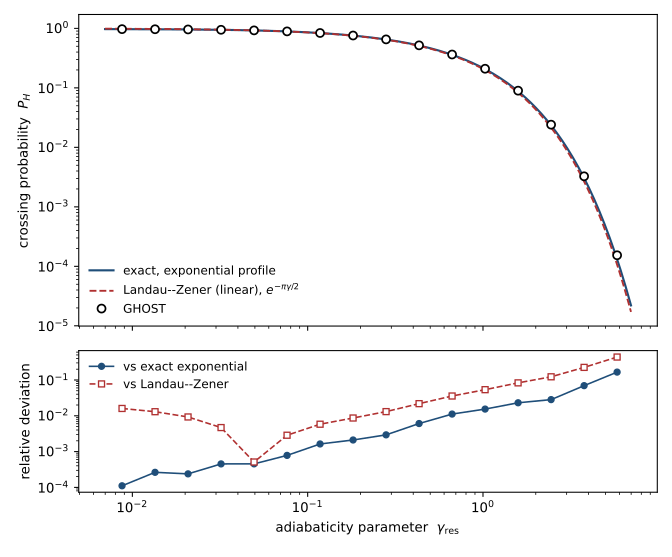
Pjump ≃ e−πγres/2probability of jumping branch (Landau–Zener, nearly linear profile)
if…γPjumpwhy
larger energy E↓↑Δ = Δm²/2E drops: smaller gap
larger Δm²↑↓larger gap
larger mixing θ (up to 45°)↑↓larger minimum gap Δ sin 2θ
density varies slowly↑↓scale |d ln ne/dx|⁻¹ large: the basis turns slowly
shock front (step)→ 0max.scale → 0: sudden jump

γ ≫ 1 → adiabatic: follows the branch · γ ≲ 1 → jumps branch

The resonance determines where the eigenstates mix maximally; adiabaticity determines whether the neutrino follows those eigenstates as they change.

Adiabaticity · 4 · supernova M15-7b

The shock front crosses the resonance

I

Part one

Curved
spacetime

Gravity is not a force: it is geometry. Far from stars, the difference is a tiny correction. Next to a compact object, it is everything.

Einstein · 1915Schwarzschild · 1916compact objectsgravitational wavescollapsars
Eclipse of 29 May 1919 · ESO / Landessternwarte Heidelberg · CC BY 4.0

25 November 1915

Einstein and his field equations
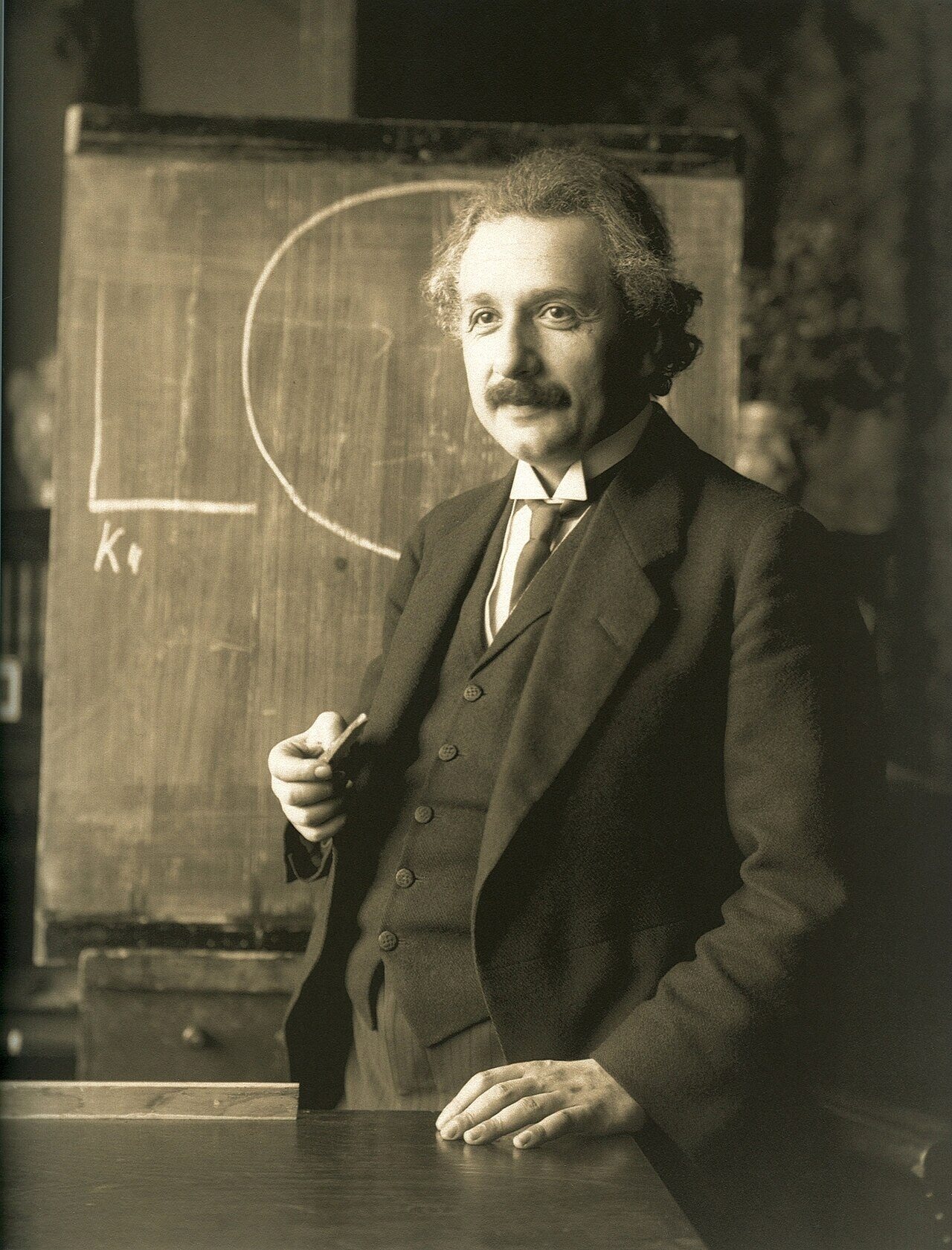
Albert Einstein, 1921F. Schmutzer · public domain
Albert Einstein1921
Gμν = 8πGc4 Tμνcurvature = energy and momentum content
d²xμdλ² + Γμαβ dxαdλ dxβdλ = 0geodesic
ds² = gμν dxμdxνthe metric is the field
“Spacetime tells matter how to move; matter tells spacetime how to curve.”
John A. Wheeler

The classical tests

Sobral, 1919: light bends
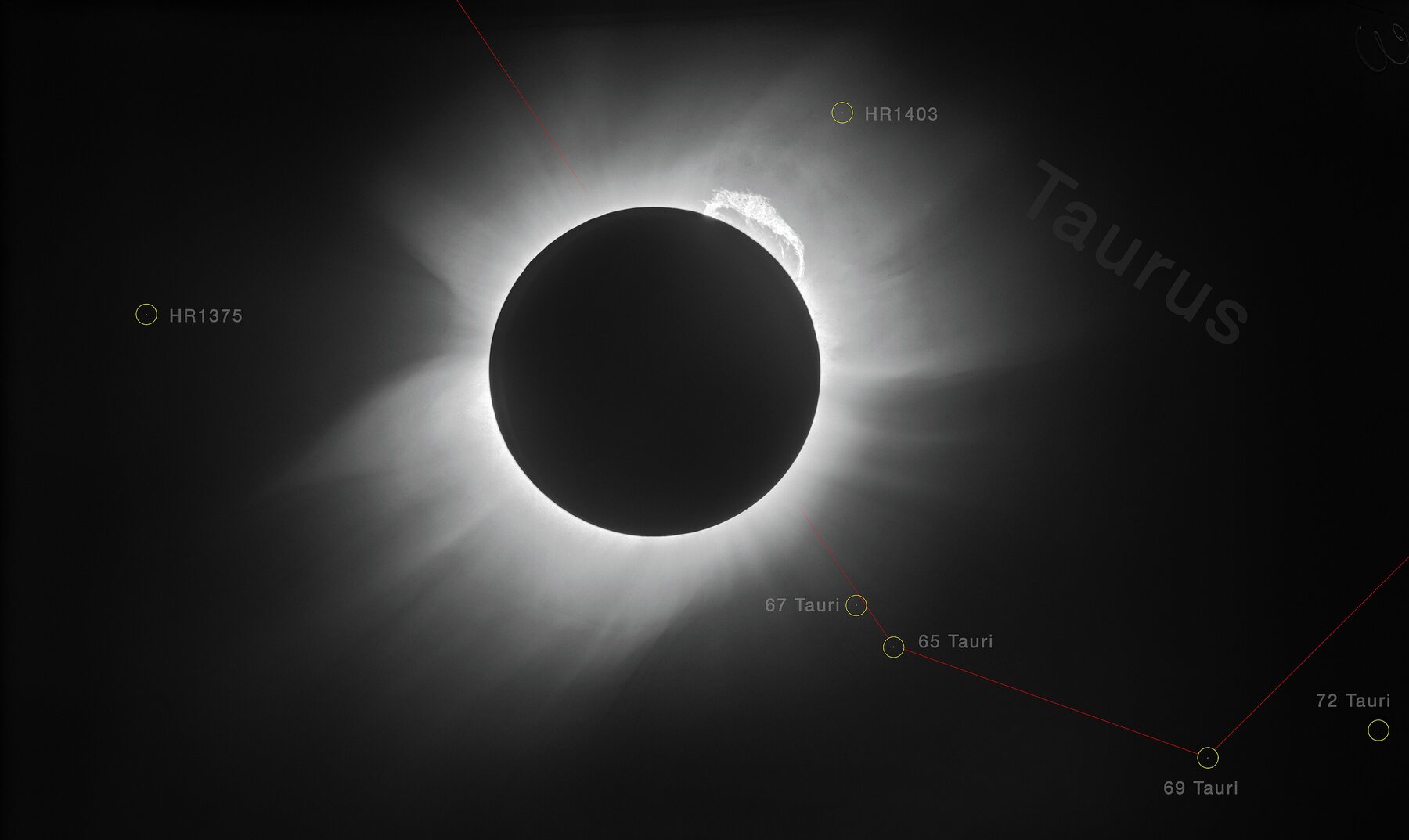
1919 eclipse plateESO / Landessternwarte Heidelberg-Königstuhl / Dyson, Eddington & Davidson · CC BY 4.0
effectGR predicts
perihelion of Mercury (1915)43″ / century
light grazing the Sun (1919)1.75″
redshift, Pound–Rebka (1959)2.5×10⁻¹⁵ over 22.5 m
Shapiro delay (1964)~200 μs
GPS clocks+38 μs / day

Sobral expedition (Ceará, Brazil): 1.98 ± 0.12″. Príncipe: 1.61 ± 0.30″. The sky over north-eastern Brazil confirmed Einstein.

1859 – 1915 · the perihelion of Mercury

Mercury’s orbit does not close

perihelion advanceper century
observed (relative to the stars)574″
other planets, by Newton531″
unexplained remainder43″
Δφ = 6πGM☉c² a(1 − e²) = 0,104″ per orbitGR · Einstein, November 1915 · 415 orbits per century → 43.0″

Le Verrier found the remainder in 1859 and proposed a hidden planet, Vulcan. It was never found. Einstein got the 43″ with no adjustable parameter.

“For a few days, I was beside myself with joyous excitement.”
Einstein to Ehrenfest, January 1916

1959 · Pound & Rebka · Jefferson tower, Harvard

Light loses energy as it climbs

14.4 keV γ rays from ⁵⁷Fe (Mössbauer effect). Pound & Rebka, PRL 4, 337 (1960): ~10%; Pound & Snider, Phys. Rev. 140, B788 (1965): ~1%. Every 12 s source and absorber swap places, as in the experiment.

The river model · Hamilton & Lisle 2008

Space falls · neutron star

Schwarzschild in Gullstrand–Painlevé · 1.4 M☉ · R = 12 kmdrag the lattice to rotate

Each node is a freely falling local frame, released from rest far away. In Gullstrand–Painlevé coordinates space is flat and flows inward at the escape velocity, v = √(2GM/r): the lattice is carried by the river. Near the mass the nodes run faster — the lines bend, cells stretch radially and squeeze sideways: the tide. At the star’s surface the river already runs at 0.59 c.

The river model · Hamilton & Lisle 2008

Space falls · black hole

Schwarzschild in Gullstrand–Painlevé · 6 M☉ · horizon at 17.7 kmdrag the lattice to rotate

The same lattice, now with no surface to stop the fall. At the horizon the river runs at exactly c: a light signal aimed outward can only stand still there, and inside it is dragged inward. That is why nothing gets out. The dashed line is the rate of a clock held at rest — it drops to zero at the horizon, where staying at rest is no longer possible.

December 1915 · Russian front

Schwarzschild and the first exact solution
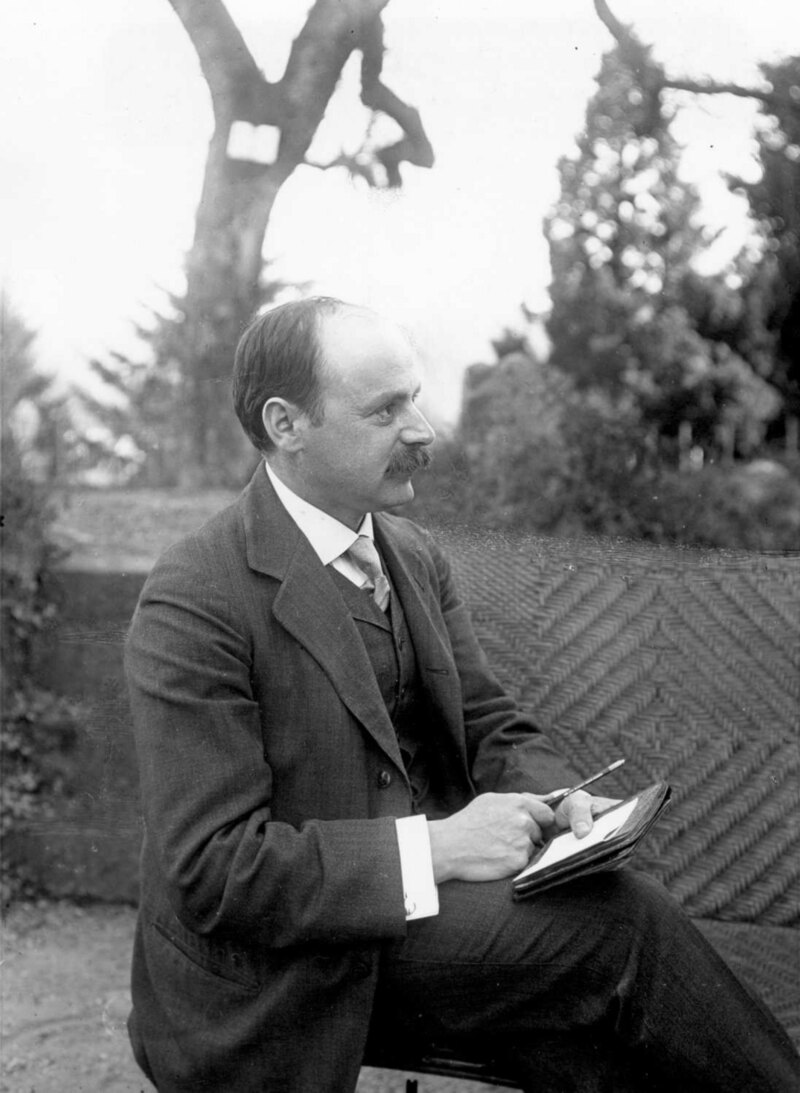
Karl Schwarzschild
Karl Schwarzschild1873 – 1916
ds² = −(1 − rsr) c²dt² + dr²1 − rs/r + r²dΩ²rs = 2GM/c² · valid outside any non-rotating spherical body

1 rs

event horizon

1.5 rs

photon sphere

3 rs

ISCO: last stable orbit

2.95 km

rs of the Sun (Earth: 8.9 mm)

He wrote to Einstein on 22 December 1915 while serving as an artillery officer. He died in May 1916.

What we need from the metric

Curvature does two things to a neutrino

1 · It changes the energy

A neutrino emitted at r with local energy E arrives at infinity with

E∞ = E √(1 − rs/r)gravitational redshift, rs = 2GM/c²

The whole spectrum slides down, and the source's clock runs slower as seen from outside.

2 · It bends the path

The trajectory is a geodesic, not a straight line. Next to a compact object the deflection is large, and different paths can connect the same source to the same detector.

Photons and neutrinos follow the same geometry, which SN 1987A confirmed to ~0.5%.

Both matter because, in a supernova, emission happens deep in the well and detection happens far from it.

And there is a third, subtler one

The oscillation phase is accumulated along the geodesic, with the particle's proper time. In flat spacetime it reduces to the familiar Δm²L/4E; in a curved metric it does not.

We come back to this in three slides.

None of this is optional when the density that sets the MSW resonance is measured in the local frame and the detector sits 10 kpc away.

How much, in numbers

What arrives is not what left

whereRu = rs/Rz
neutrinosphere, 1.4 M☉30 km0.1380.077
cooler neutrinosphere50 km0.0830.044
cold neutron star12 km0.3450.235
collapsar disk, 3 M☉3 rs0.3330.225

During accretion, the spectrum DUNE sees left the star ~8% more energetic than it arrives.

And so does the time interval: what the star lives in 1 s, we measure in 1.08 s. The neutrino light curve is read with the wrong clock if the metric is ignored.

Why this matters for the resonance

The MSW condition involves the local energy. Using the detected energy instead shifts the resonance density by ~8%, and therefore shifts the radius where the conversion happens.

u and z computed with rs = 2GM/c²; z = (1 − u)−1/2 − 1.

Dashboard · Schwarzschild null geodesics

Light and neutrinos near a black hole

interactive · RK4 in the browseru″ + u = (3/2) rs u², u = 1/r

Every ray arriving with b < 3√3 M falls in. Just above that, it loops around the photon sphere before escaping.

An ultra-relativistic neutrino follows, to first order, the same null geodesic. Mass enters as a correction ∝ m²/E² — and that correction is exactly what carries the oscillation phase.

Compactness · 1/8

Where GR stops being a correction

1/8 · Earth

z = (1 − rs/R)−1/2 − 1 · clock at rest on the surface compared with infinity · deflection from the exact orbit integral (weak field: 2rs/R).

Compactness · 2/8

Where GR stops being a correction

2/8 · Sun

z = (1 − rs/R)−1/2 − 1 · clock at rest on the surface compared with infinity · deflection from the exact orbit integral (weak field: 2rs/R).

Compactness · 3/8

Where GR stops being a correction

3/8 · Sirius B

z = (1 − rs/R)−1/2 − 1 · clock at rest on the surface compared with infinity · deflection from the exact orbit integral (weak field: 2rs/R).

Compactness · 4/8

Where GR stops being a correction

4/8 · proto-neutron star

z = (1 − rs/R)−1/2 − 1 · clock at rest on the surface compared with infinity · deflection from the exact orbit integral (weak field: 2rs/R).

Compactness · 5/8

Where GR stops being a correction

5/8 · neutron star

z = (1 − rs/R)−1/2 − 1 · clock at rest on the surface compared with infinity · deflection from the exact orbit integral (weak field: 2rs/R).

Compactness · 6/8

Where GR stops being a correction

6/8 · ISCO

z = (1 − rs/R)−1/2 − 1 · clock at rest on the surface compared with infinity · deflection from the exact orbit integral (weak field: 2rs/R).

Compactness · 7/8

Where GR stops being a correction

7/8 · photon sphere

z = (1 − rs/R)−1/2 − 1 · clock at rest on the surface compared with infinity · deflection from the exact orbit integral (weak field: 2rs/R).

Compactness · 8/8

Where GR stops being a correction

8/8 · horizon

z = (1 − rs/R)−1/2 − 1 · clock at rest on the surface compared with infinity · deflection from the exact orbit integral (weak field: 2rs/R).

Compact objects

The zoo where only GR works
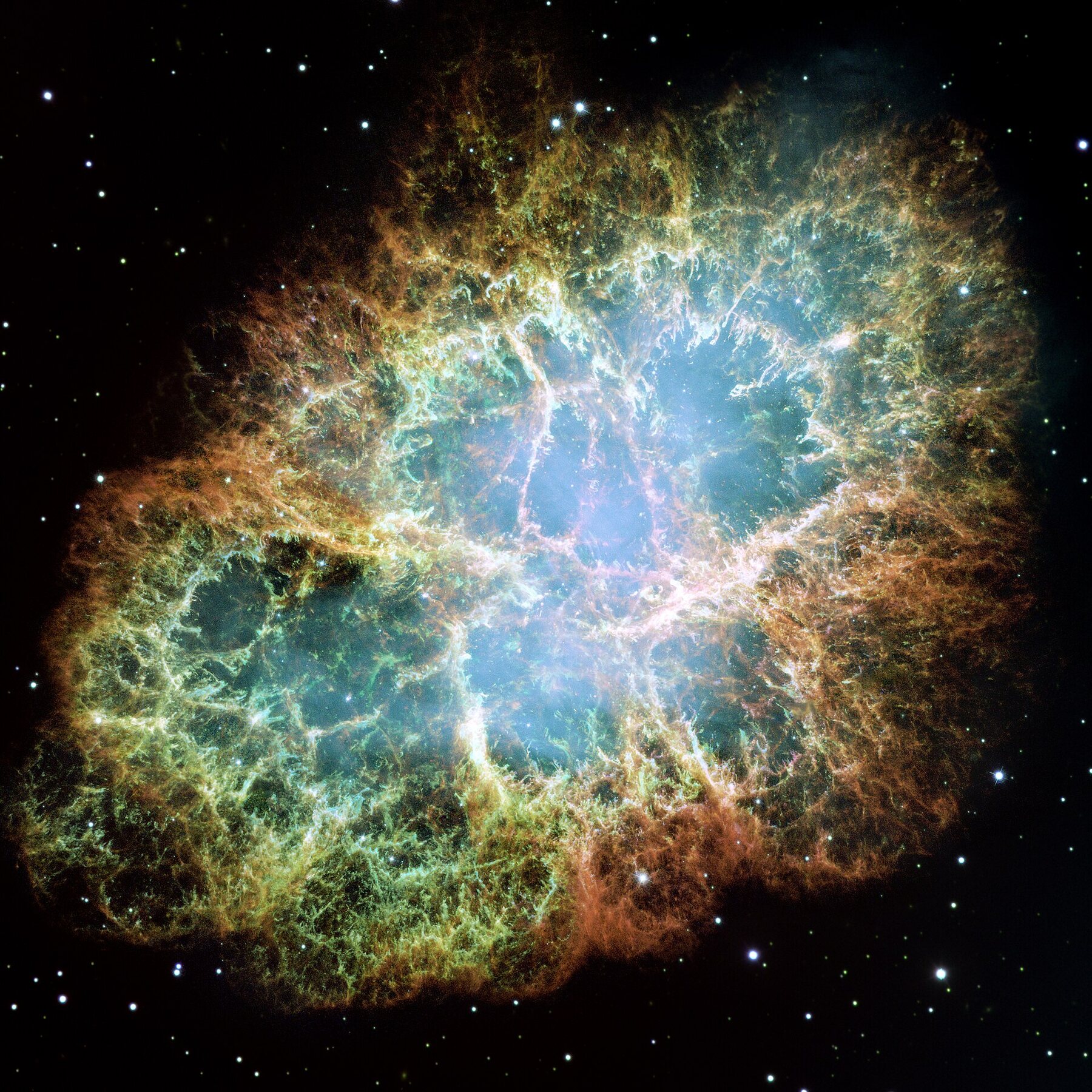
Crab NebulaNASA, ESA, J. Hester & A. Loll · PD
Crab — remnant of the supernova of 1054, with a 33 ms pulsar at its centre.
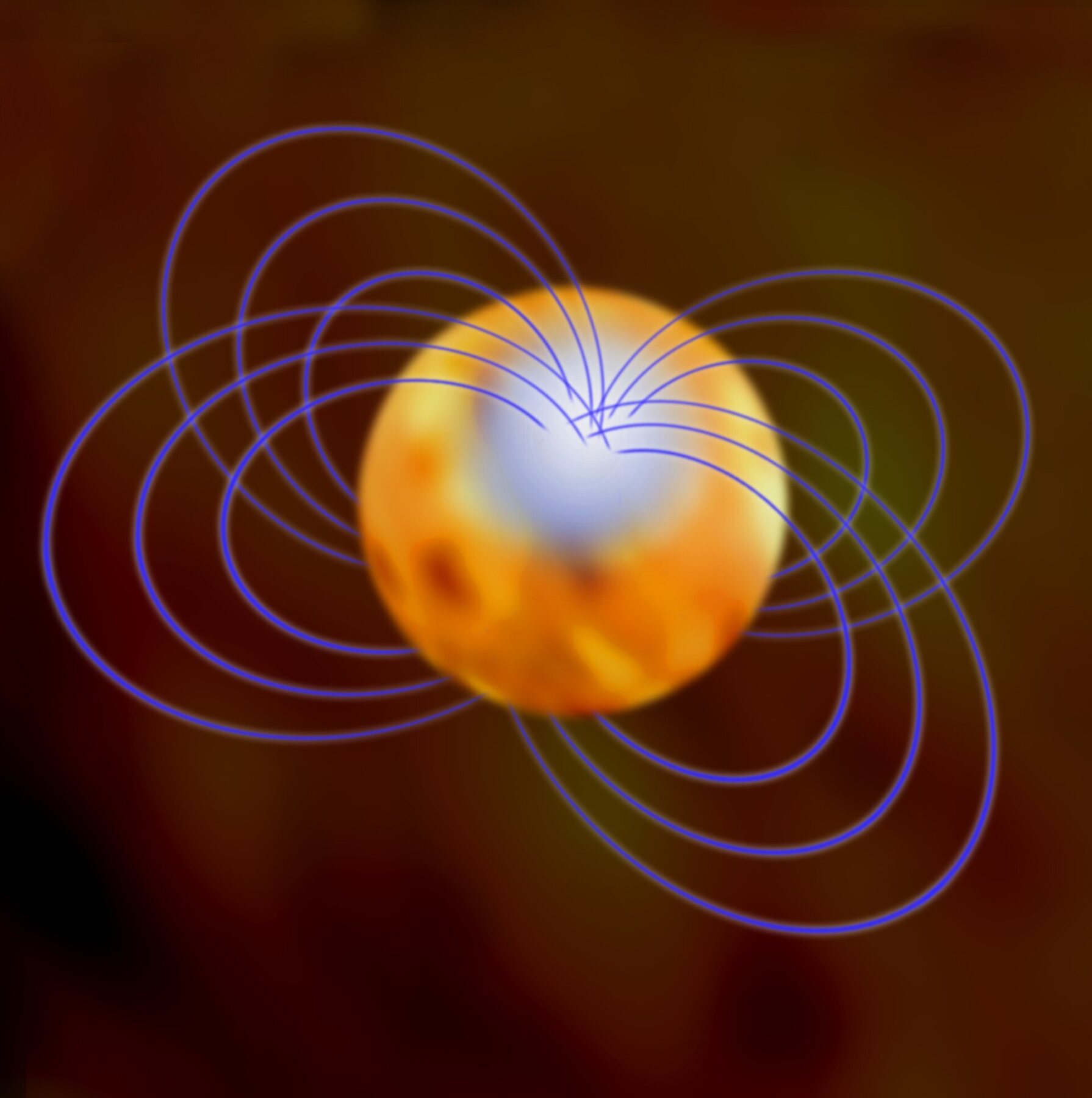
Neutron star illustrationNASA/CXC/M. Weiss · PD
Neutron star — 1.4 M☉ in 12 km, central density of several 10¹⁴ g/cm³.
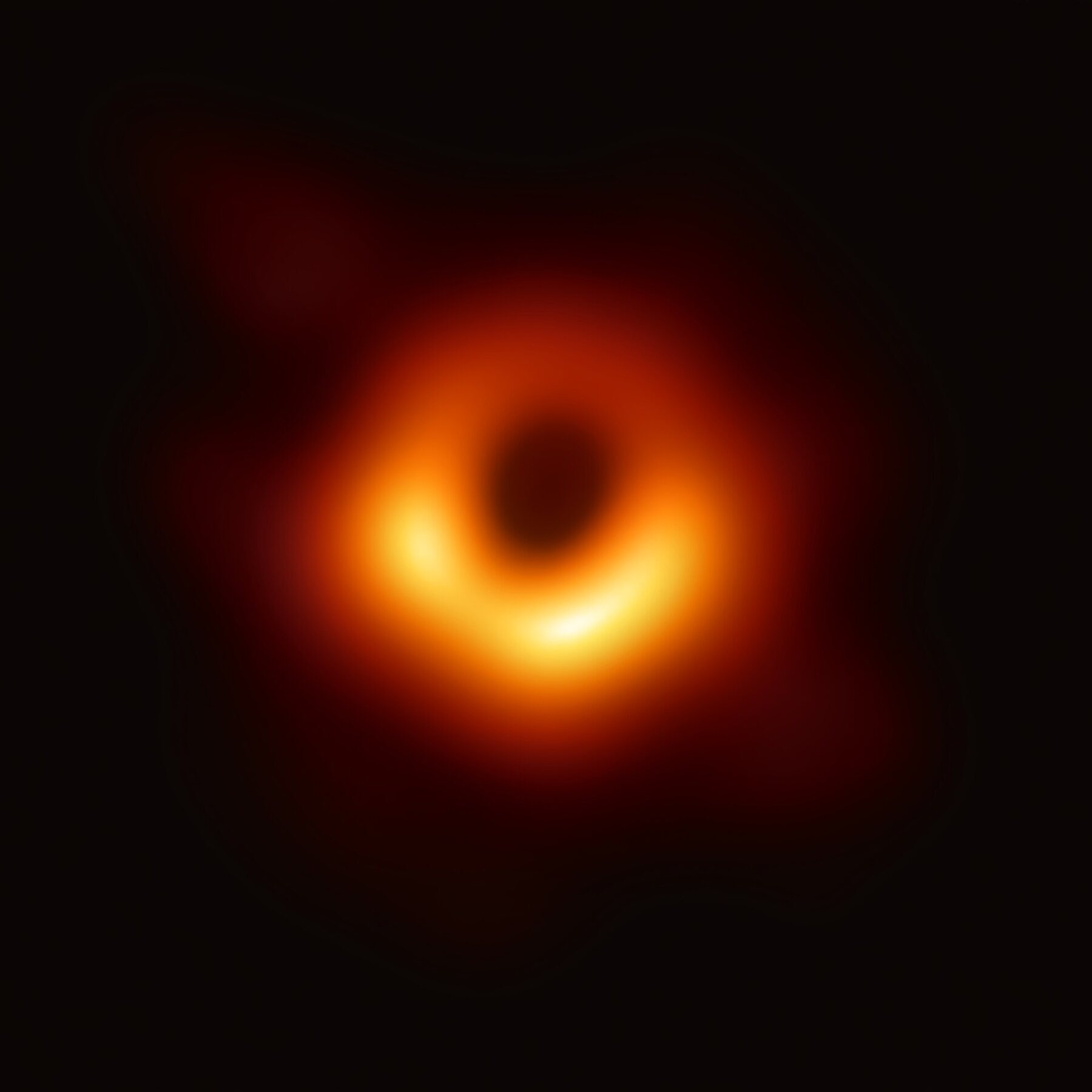
Shadow of the M87* black holeEHT Collaboration · CC BY 4.0
M87* (EHT, 2019) — 6.5 billion M☉; 42 μas ring.
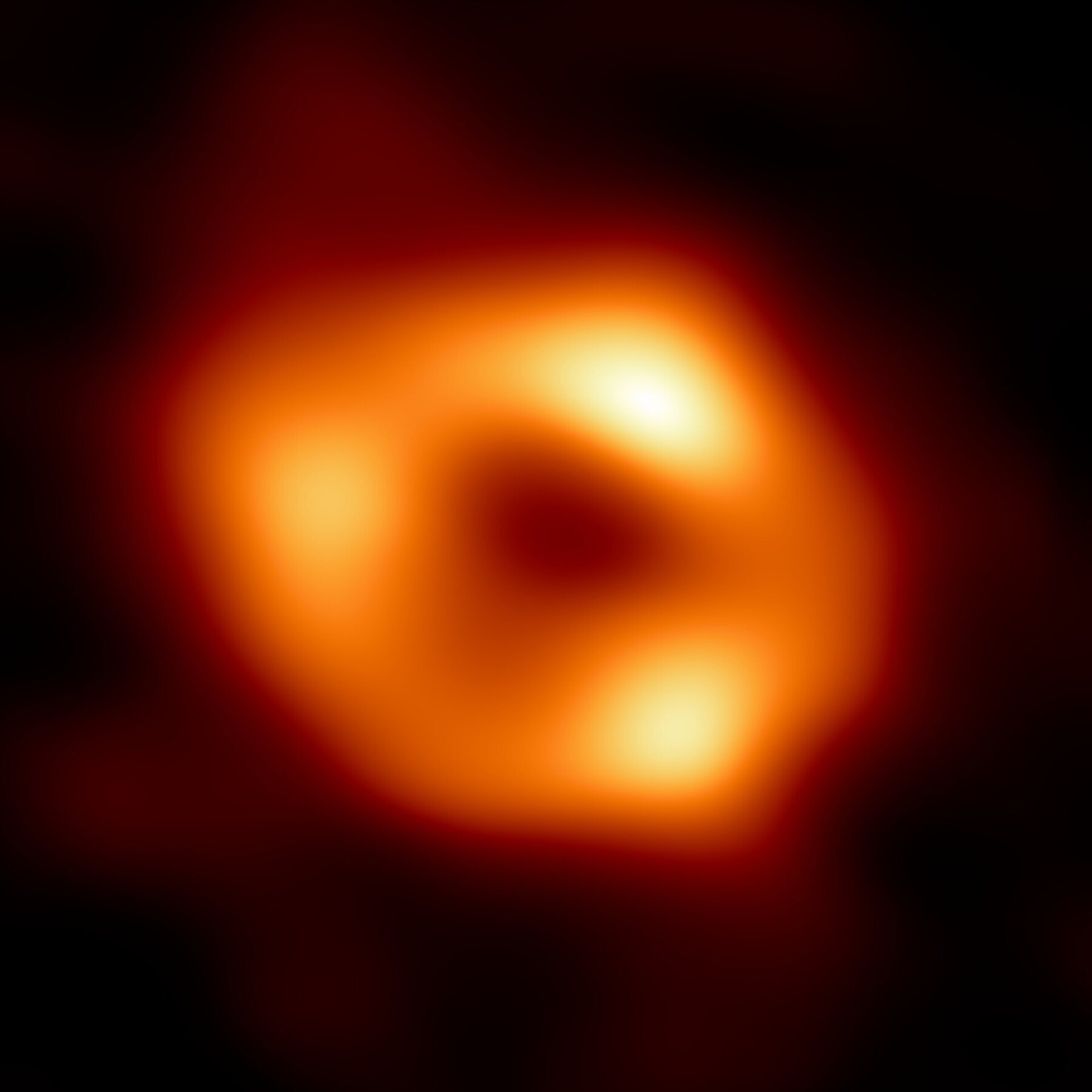
Sagittarius A*EHT Collaboration · CC BY 4.0
Sgr A* (EHT, 2022) — 4 million M☉, at the centre of the Milky Way.

Strong gravity, measured

Binary pulsars and gravitational waves
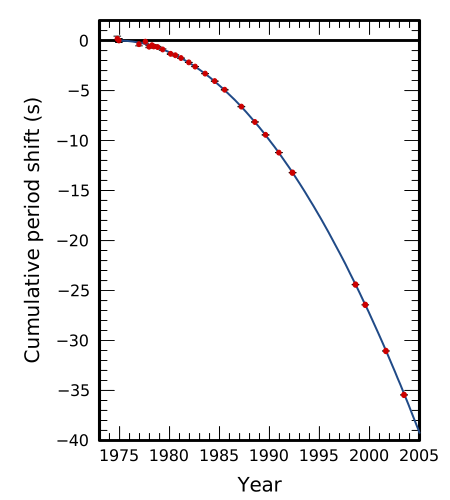
Periastron shift of PSR B1913+16Inductiveload · public domain
PSR B1913+16 (Hulse & Taylor, 1974; Nobel 1993): the orbit shrinks exactly as gravitational-wave emission predicts.
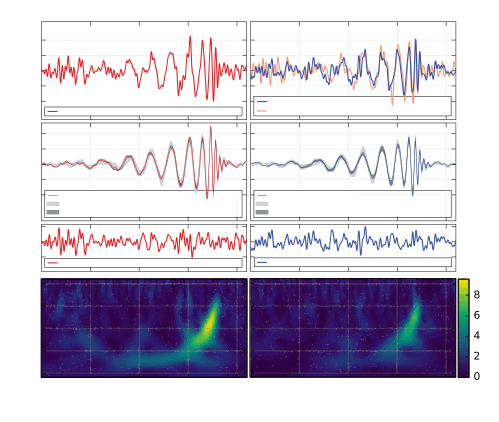
GW150914 measured by LIGOLIGO/Virgo · CC BY 3.0
GW150914: 36 + 29 M☉ → 62 M☉; three solar masses became gravitational waves (Nobel 2017).

Stodolsky 1979 · Fornengo, Giunti, Kim & Song 1997

The phase along the geodesic

Φk = ∫ pμ(k) dxμcovariant phase: valid in any metric
Φk = mk22E∞ ∫ dr√(1 − b²(1 − rs/r)/r²)Schwarzschild, first order in m², along the null geodesic

One-line derivation: with E and J = Eb conserved, Et − Jφ − ∫prdr cancels everything except the mass term.

1 · Radial: gravity “hides”

Φ = Δm²(rB − rA)/2E∞, the same form as flat space. But in local quantities (proper distance ∫dr/√B, energy Elocal) the flat formula is wrong.

2 · Non-radial: the path matters

The phase depends on b. Different paths between the same source and detector accumulate different phases.

3 · Many paths: interference

In a lens, the phase difference between paths is ∝ mk², not just Δm²: gravity gives access to the absolute mass.

Dashboard · a geodesic born at the source

Redshift, bending and phase from emission

automatic · exact Fornengo et al. integral along the orbit

II

Part two

Neutrinos in
curved spacetime

They are born inside the well. They cross regions light cannot cross. And they reach us carrying a phase that remembers the path.

messengerscovariant phasebending and redshiftlensingDUNE
GRB illustration · NASA/CXC/M. Weiss · public domain

23 February 1987 · Large Magellanic Cloud

SN 1987A: neutrinos before the light
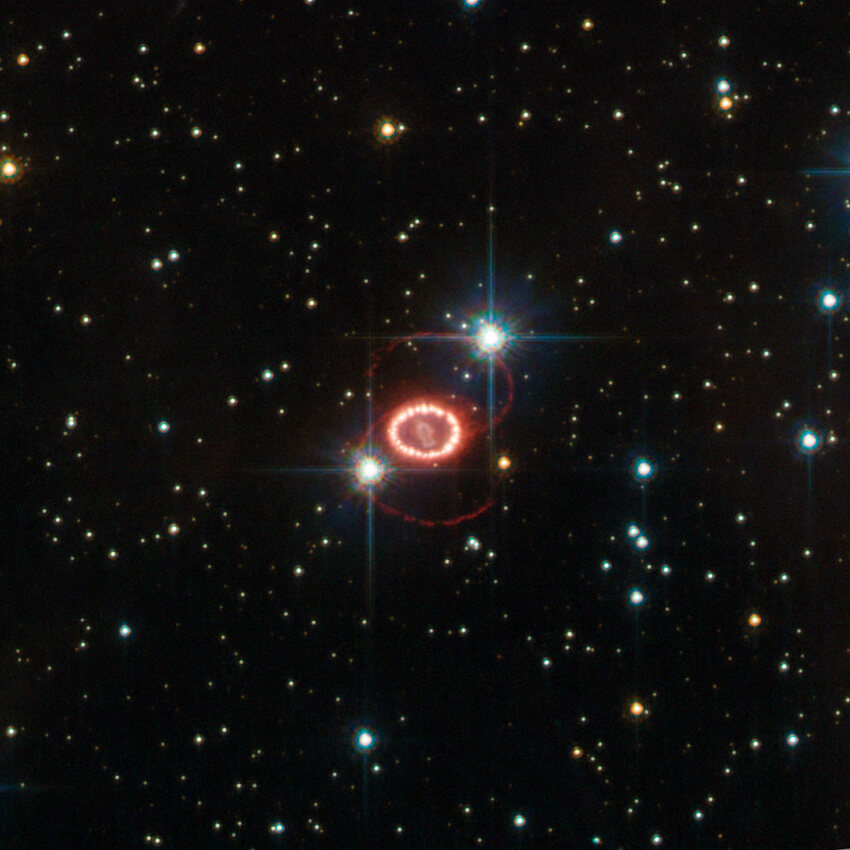
SN 1987A by HubbleESA/Hubble & NASA · CC BY 4.0

11

Kamiokande-II

8

IMB

5

Baksan

Within ~13 s, from 168,000 light-years. They arrived hours before the light: photons are trapped in the envelope, neutrinos are not. 99% of the ~3×10⁵³ erg of the collapse leaves as neutrinos.

A gravity test with two dozen events

Neutrinos and photons suffered the same Shapiro delay in the Galaxy's potential (months) — to within ~0.5% (Krauss & Tremaine; Longo, 1988). Neutrinos fall like light.

Anatomy · core-collapse supernova

The phases, and when each one happens

phasewhenradiuswhat happens
collapse−200 to 0 ms3,000 → 30 kmthe iron core loses pressure and falls at ~0.25 c
bouncet = 0~10 kmnuclear matter stiffens and the inner core rebounds
prompt shock0 – 5 ms10 → 100 kmborn at the sonic point, it runs outward
νe breakout~5 ms~100 km~1053 erg/s as it crosses the neutrinosphere
stalling~20 ms~150 kmbecomes a standing accretion shock
ν heating0.1 – 1 s100 – 200 kmthe gain region receives a few per cent of the luminosity
revival~0.3 s~200 kmthe shock moves again: the star explodes
propagation1 s – hours10³ → 10⁶ kmit crosses the mantle and the envelope

The energy budget

The gravitational binding energy released is 3×1053 erg. Of that, 99% leaves as neutrinos, and only ~1051 erg becomes kinetic energy of the explosion.

A supernova is, first of all, a neutrino event. The light is loose change.

Before the table: a day of silicon burning builds the ~1.4 M☉ iron core. During infall, above 1012 g/cm³ the νe become trapped, and the bounce occurs at 2.7×10¹⁴ g/cm³.

Timings from the delayed mechanism of Bethe & Wilson (1985). Radii depend on the progenitor; these are typical of ~15 M☉.

Seen from outside

The explosion, the remnant and the pulsar

What the previous table describes from the inside, as a telescope would see it: the star flares, the shock breaks through the surface, the debris expands — and at the centre the neutron star remains, now a pulsar, with its wind nebula.

shock breakoutremnantpulsar + nebula

Artist’s animation · NASA’s Goddard Space Flight Center Conceptual Image Lab (animation: Jonathan North) · SVS 20413 · public domain. The neutrinos left hours before the first flash.

The delicate point of the mechanism

The shock stalls, and must be revived

The prompt shock does not blow up the star. It spends all its energy before getting out.

Photodisintegration

Breaking iron into nucleons costs 8.8 MeV per nucleon. Crossing 0.1 M☉ of iron consumes ~1.7×1051 erg, of the order of the shock's whole energy.

Neutrino losses

As it crosses the neutrinosphere, the freshly shocked matter becomes transparent and dumps the breakout burst. More energy gone.

Within ~20 ms it stops at ~150 km: it becomes a standing accretion shock.

What revives it

Between the neutrinosphere and the shock lies the gain region, where absorption of νe and ν̄e beats emission. A few per cent of the luminosity deposited there is enough to push the shock back out.

νe + n → p + e−  ·  ν̄e + p → n + e+the heating that reignites the explosion

But the deposition is marginal: in spherical symmetry it almost never suffices. What closes the budget is convection and the SASI, which hold matter longer in the gain region.

That is why the problem was only settled in 3D, and why every progenitor explodes at a different instant.

Animation · the delayed mechanism

Neutrinos relight the shock

Schematic, not a simulation: radii and times typical of a ~15 M☉ star (those in the phase table), Bethe & Wilson (1985) mechanism. Violet: neutrinos leaving the neutrinosphere; orange: those depositing energy in the gain region.

Astrophysics · Woosley 1993

Collapsars: when a star fails to explode
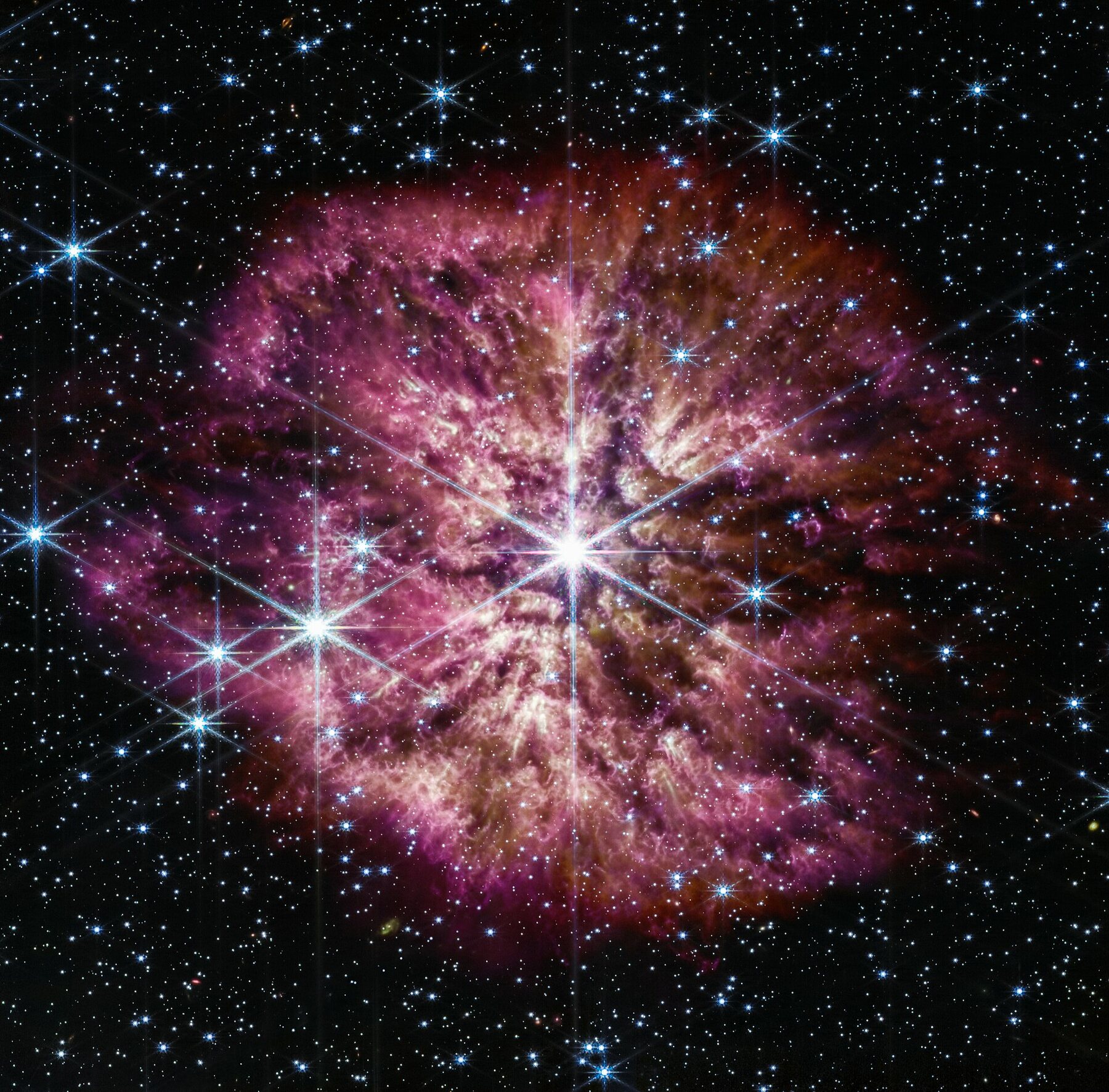
Wolf-Rayet star WR 124 seen by JWSTNASA, ESA, CSA, STScI, Webb ERO · CC BY 4.0

A rapidly rotating Wolf–Rayet star of ~30 M☉ that has lost its hydrogen envelope.

  • The iron core collapses and the shock does not revive: a black hole of ~2–3 M☉ forms.
  • The envelope has too much angular momentum to fall straight in: an accretion disk forms a few rs out.
  • Accretion at 0.01–1 M☉/s for tens of seconds → relativistic jets that drill through the star.

WR 124, imaged by JWST in 2023: the kind of star that may end this way.

MacFadyen & Woosley 1999 · Popham, Woosley & Fryer 1999

An engine cooled by neutrinos

relativistic jet → long GRB ν, ν̄ ~10⁵² erg/s rotating envelope falling in black hole · 2–3 M☉ disk: T ~ MeV, ρ ~ 10¹⁰⁻¹² g/cm³

In the inner disk, matter is so hot and dense that photons are trapped. What carries the heat away are neutrinos: an NDAF (neutrino-dominated accretion flow).
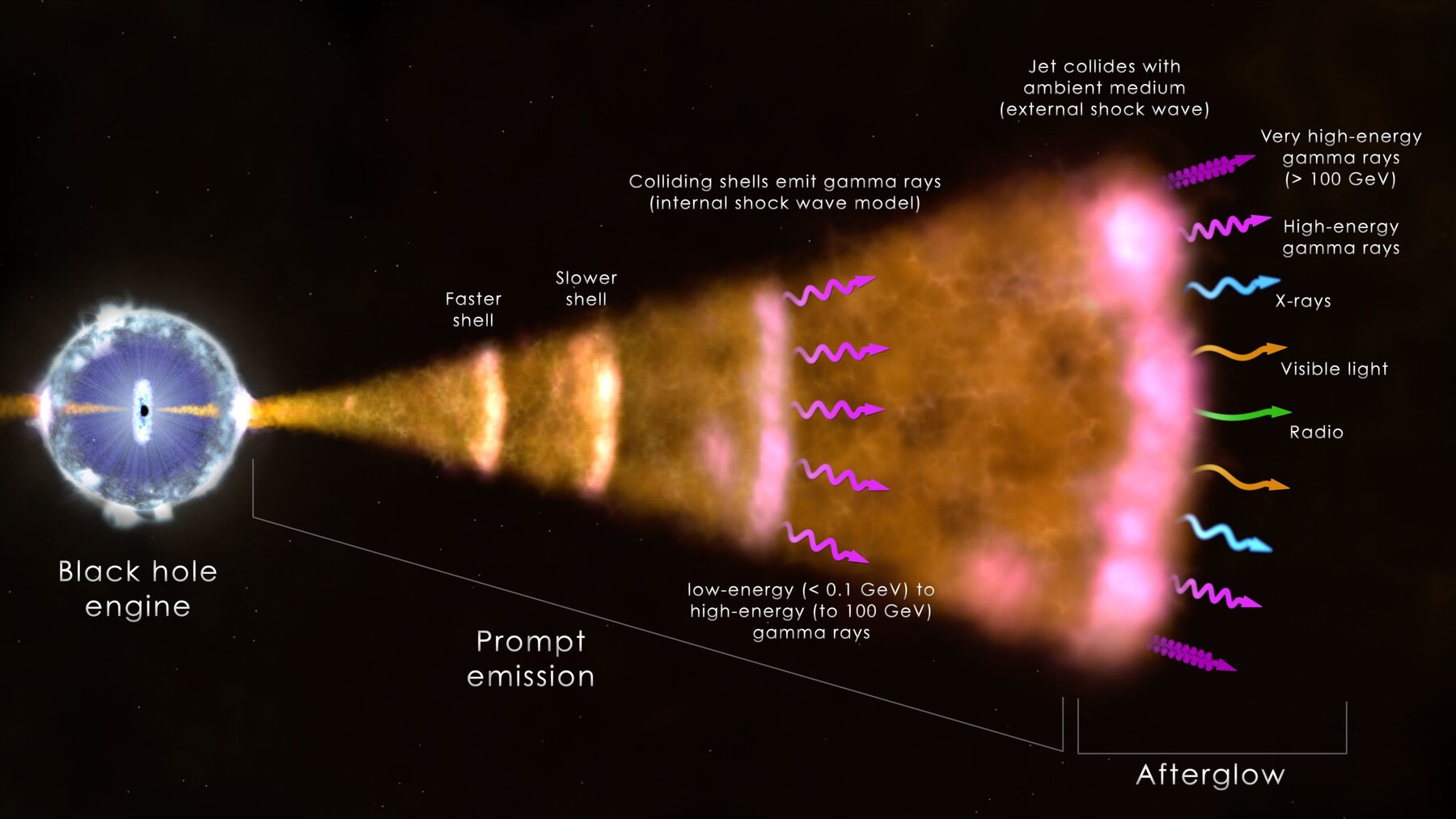
Gamma-ray burst schematicNASA/GSFC/ICRAR · PD

And these neutrinos are emitted a few rs from a spinning black hole, where the geometry is Kerr, not Minkowski.

Where neutrinos are born

Emission happens inside the well

sourceemission radiusrs/REemitted/E∞
Sun, core~0.2 R☉2×10⁻⁵1.00001
proto-neutron star, ~1 sneutrinosphere ≈ 30 km0.141.08
neutron star, late≈ 12 km0.341.24
collapsar disk, ISCO (Schwarzschild)3 rs, orbiting0.331.41
disk around a fast Kerr hole< 3 rs> 0.5> 1.4 · + Doppler

The energy DUNE measures is E∞. The energy that enters the MSW potential, the collisions and the collective conversions is the local one — up to 40% larger.

Rays leave bent: the neutrinosphere looks bigger, and the angular distribution of the neutrinos crossing above it changes.

In the disk the ratio is ut = (1 − 3M/r)−1/2: gravitational and transverse redshift together. Doppler from the orbital motion adds or subtracts depending on direction.

Dashboard · Swami, Lochan & Dixit 2020

A gravitational lens weighs the neutrino

interactive
normal orderinginverted

Source at 10 kpc, lens halfway. Two paths, b₊ and b₋. The common phase, ~m²L/E, is huge and washes out with any energy resolution. The difference between paths survives:

ΔΦk = mk2 Δb24E (1rA + 1rB)

Each mass eigenstate makes its own fringe. Change the lightest mass: the pattern changes, and the ordering leaves a mark too.

Point lens, weak field, no matter; amplitudes ∝ √|μ±|.

The frontier

What gravity can tell us

Absolute mass

Interference between lensed paths is sensitive to mk² and to the ordering (Fornengo et al. 1997; Swami et al. 2020).

Flavour near the source

MSW and collective conversions in local quantities; bent rays change the “halo” and fast flavour instabilities (Cherry et al. 2012).

Black-hole formation

The neutrino signal of a supernova that turns into a black hole is cut off abruptly: a clock for time-of-flight and mass measurements (Beacom, Boyd & Mezzacappa 2001).

Nucleosynthesis

In collapsar disks, the ν and ν̄ spectra that set Ye are shifted and focused by GR — changing heavy-element production (Caballero, McLaughlin & Surman 2012).

Equivalence principle

If different flavours felt gravity differently, oscillation would gain a term ∝ ΔγΦE (Gasperini 1988; Halprin & Leung 1991).

Decoherence

Wave packets of different masses separate; in strong fields, Shapiro delays and deflections also depend on mk.

Deep Underground Neutrino Experiment

DUNE: 1,300 km from Fermilab to South Dakota

Fermilab Illinois · LBNF beam 1.2 → 2.4 MW SURF South Dakota 1.5 km 1,300 km through the crust maximum beam depth ≈ 33 km rs⊕/R⊕ ≈ 1.4 × 10⁻⁹ · for the beam, spacetime is flat

Far detector: 4 modules of ~17 kt of liquid argon (TPCs), 1.5 km underground. ProtoDUNE, at CERN, is the full-scale prototype.
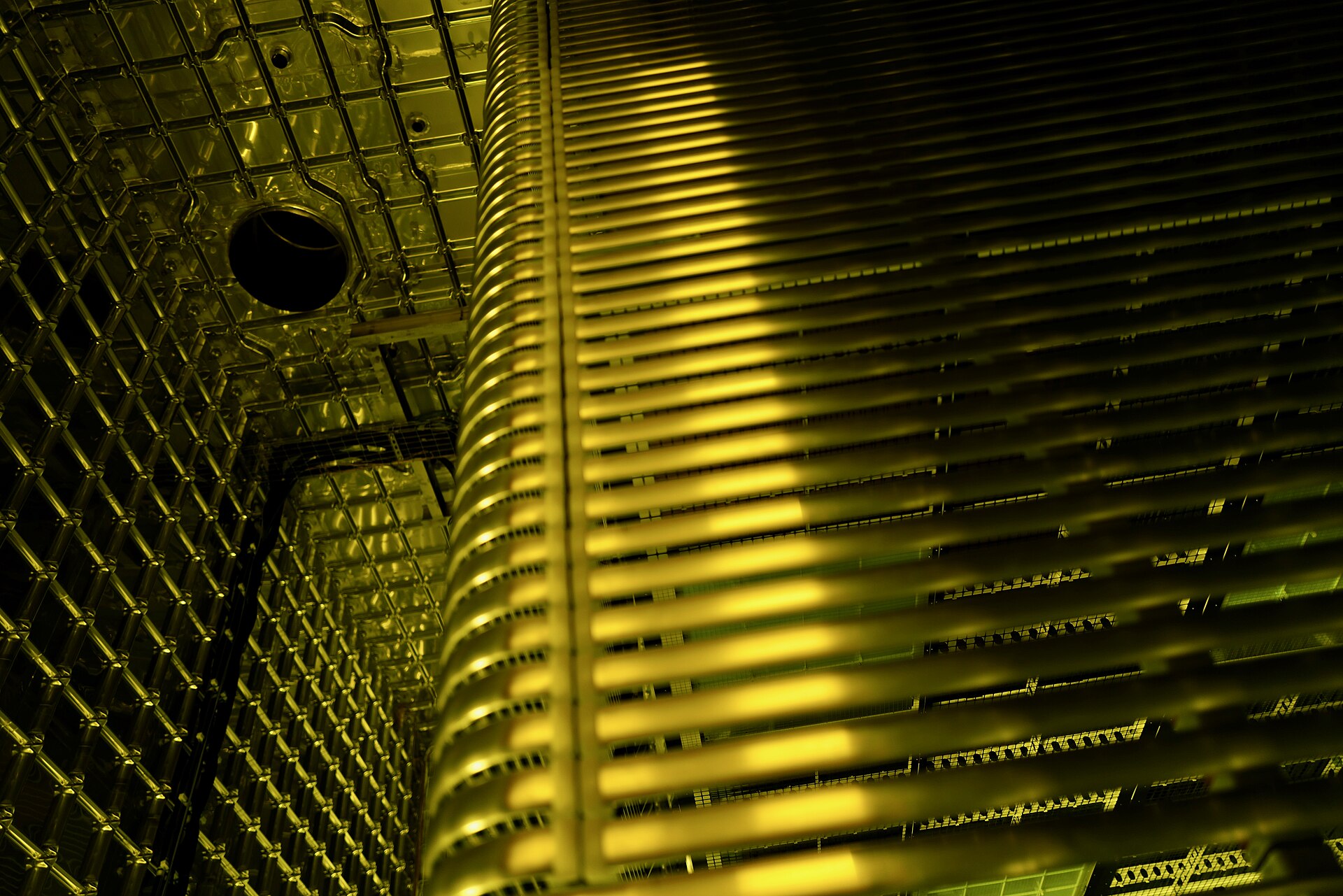
Inside ProtoDUNEMark Benecke · CC BY-SA 4.0

Goals: δCP, ordering, octant — and supernova neutrinos.

Dashboard · νe appearance at DUNE

CP and ordering in one plot

interactive
νμ → νeν̄μ → ν̄eδ = 0, 90°, 180°, 270°

L = 1,285 km, crust with ρ = 2.85 g/cm³. Cervera et al. (2000) expansion in θ₁₃ and Δm²₂₁/Δm²₃₁.

The matter effect separates ν from ν̄ depending on the ordering; δCP shifts and reshapes the peak.

A supernova in the Galaxy

DUNE is unique for νₑ (νₑ + ⁴⁰Ar → e⁻ + ⁴⁰K*): thousands of events for an SN at 10 kpc, with the neutronization peak and, if it happens, the cut-off of black-hole formation.

A network of observatories

Ears open for the next collapse
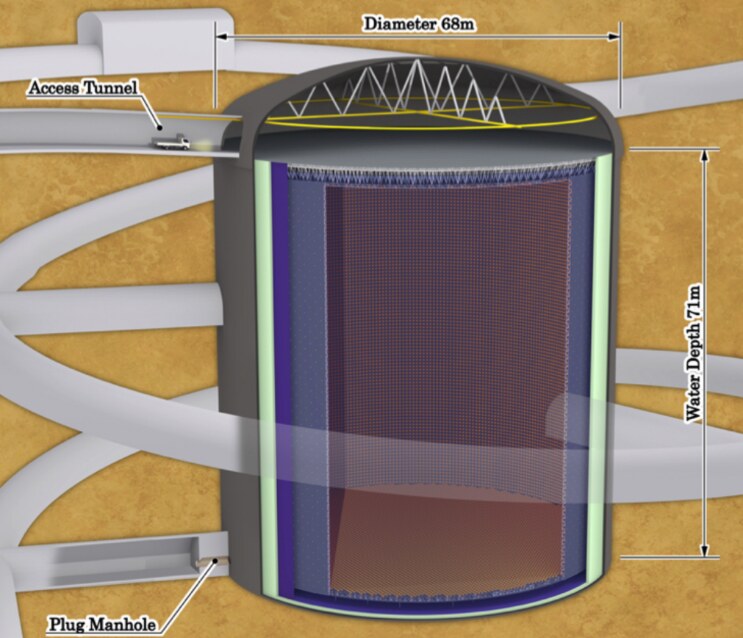
Hyper-Kamiokande schematicHyper-K Collab. · CC BY 3.0
Hyper-Kamiokande — 260 kt of water, ~2028. Thousands of ν̄ₑ from a galactic SN.
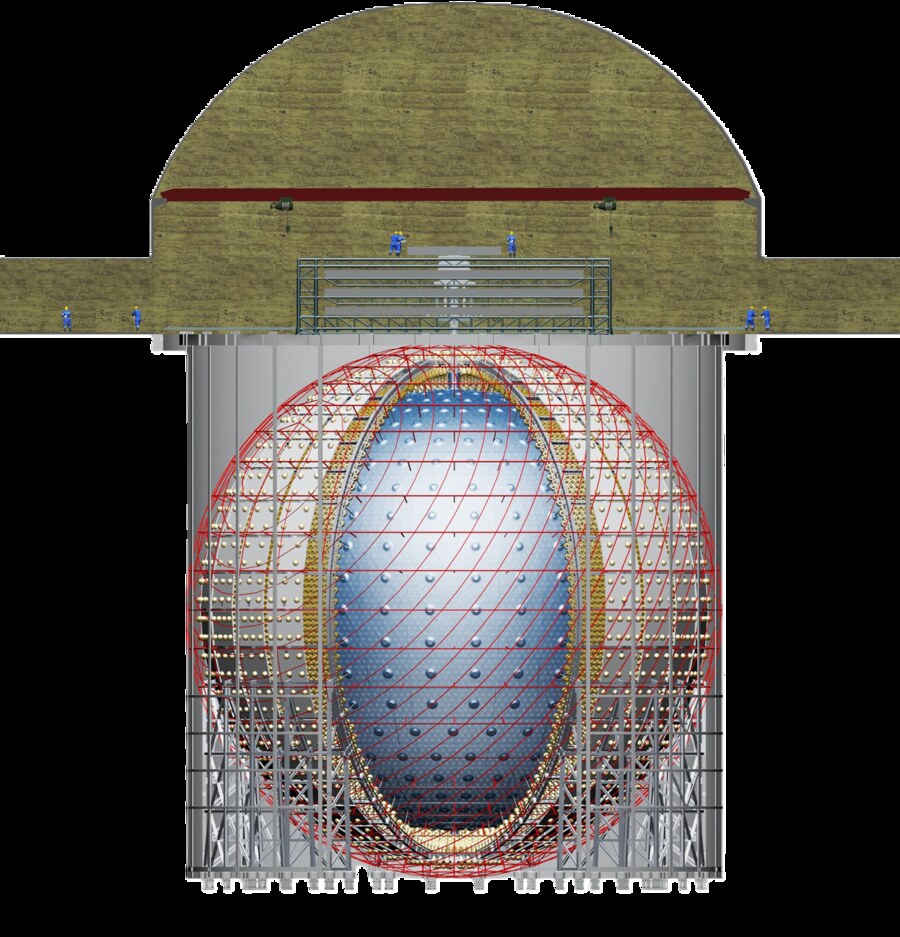
JUNO schematicJUNO Collab. · CC BY 4.0
JUNO — 20 kt of scintillator in Jiangmen, running since 2025. Ordering from reactors at 53 km.
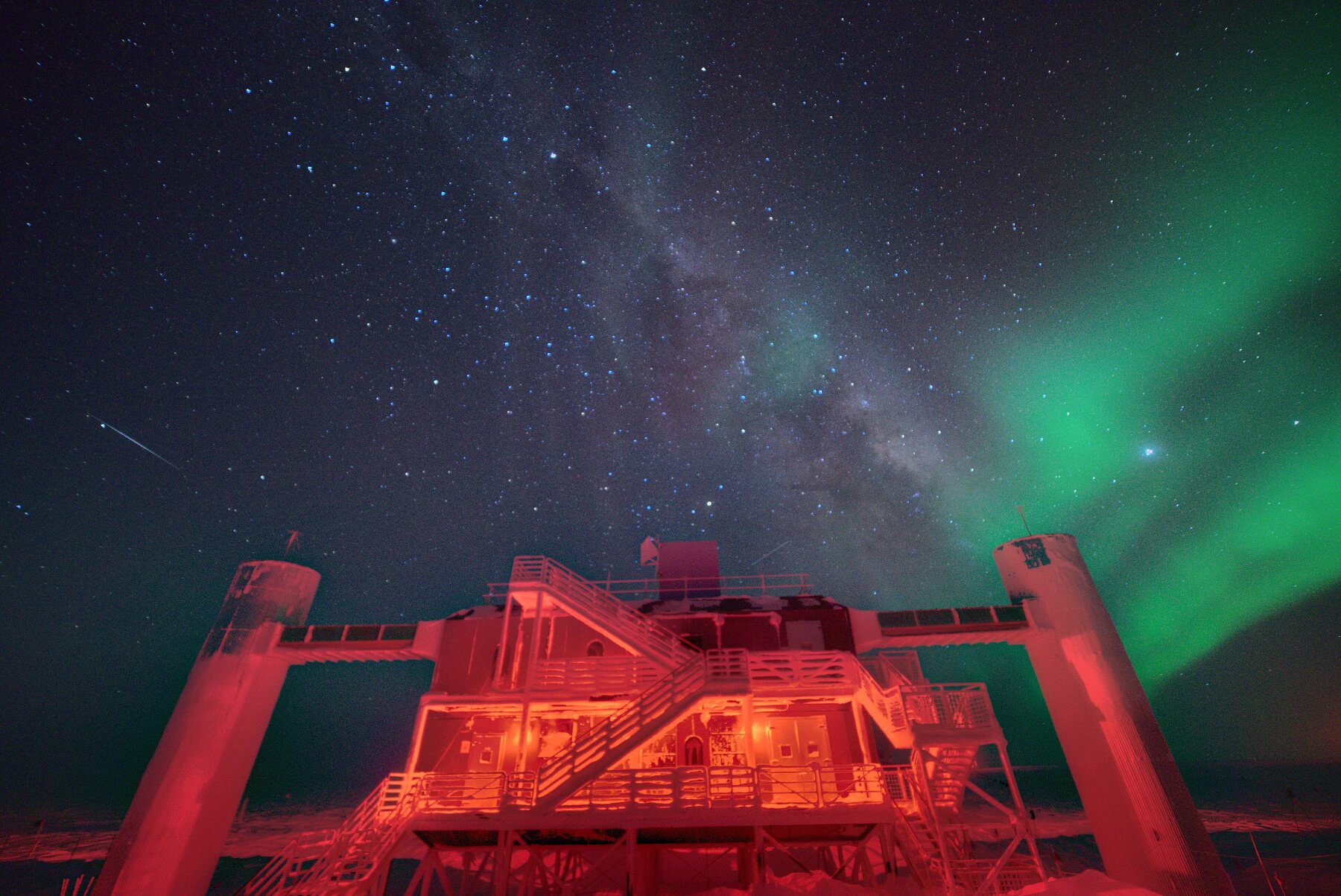
IceCube Lab at nightJohn Hardin · CC BY 4.0
IceCube — 1 km³ of ice at the South Pole. TXS 0506+056 (2017), NGC 1068, the Galactic plane.
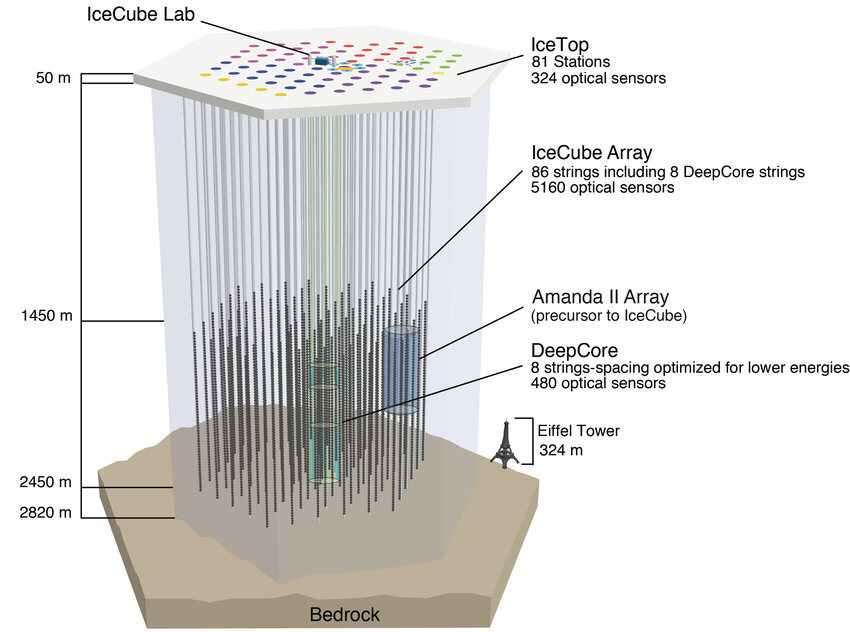
IceCube schematicIceCube Collab. · CC BY 4.0
The detector: 5,160 optical modules between 1.45 and 2.45 km deep. And KM3NeT, in the Mediterranean, saw ~220 PeV (2025).

Where the resonances live

Two densities, two encounters

The star offers every density between 1014 g/cm³ in the core and almost nothing in the envelope. Each resonance picks its own.

ρres = Δm² cos 2θ · mN / (2√2 GF E Ye)the same condition, with each pair's Δm² and θ
resonanceΔm²ρ at 20 MeV
H, θ₁₃2.5×10⁻³ eV²1.6×10³ g/cm³
L, θ₁₂7.5×10⁻⁵ eV²19 g/cm³

Both sit in the envelope, not in the core: the H resonance lies tens of thousands of kilometres from the centre, and the L one further still.

Only one of them meets the shock

The shock front takes seconds to sweep the envelope. When it passes 1.6×10³ g/cm³ it crosses the H resonance. By the time it reaches the 19 g/cm³ of the L, it is already weak and diffuse.

That is why the rest of this talk is about H.

Ye = 0.5. The density scales as 1/E: at 5 MeV the H resonance sits at 6.3×10³ g/cm³, and at 60 MeV at 5.3×10².

The bridge to Part III · M15-7b

The front sweeps the envelope and crosses the H resonance

Once revived, the shock runs outward at ~1.6×10⁴ km/s, sweeping the envelope.

The MSW-H resonance does not live at a radius: it lives at a density.

ρres ≈ 1.6×10³ g/cm³ at 20 MeV · 6.3×10³ at 5 MeV · 5.3×10² at 60 MeV

Because the shock compresses and pushes the envelope, the radius where that density lives moves inward while the shock moves outward. The two are going to meet.

after bounceshock radiusresonance radius
3.0 s35,011 km34,933 km
10.0 s149,106 km12,471 km

At t ≈ 3 s they coincide

78 km apart out of 35,000, or 0.2%. For a window a few seconds wide the shock front sits right on the resonance, and that is where the neutrino's flavour is decided.

Profiles derived from M15-7b, Garching CCSN Archive (A. Wongwathanarat), angular medians.

III

Part three · results

GHOST

Which density structures in a supernova change the flavour that reaches DUNE — and what it costs to ignore the only one that matters: the shock front at the MSW resonance.

Chebyshev propagatorH resonanceshock front12,878 raysDUNE

The code

GHOST: flavour oscillation without shortcuts

H(r) = 12E U diag(0, Δm²₂₁, Δm²₃₁) U† + diag(√2 GF Yeρ(r)/mu, 0, 0)three flavours, with CP phase, along each ray
|ψ(r+Δr)⟩ = e−iHΔr |ψ(r)⟩ ≈ Σk ck Tk(H̃) |ψ⟩Chebyshev expansion · rigorous spectral bounds · bisected slices

C core (a fork of DAEDALUS, the quantum-walks-on-graphs code by Prof. Edgard Amorim and me). The complex Hamiltonian runs in a real 2n×2n embedding; exposed as a SNEWPY FlavorTransformation, the rest of the pipeline is unchanged.

validationresult
against NuOscProbExact (independent method)2.2×10⁻¹⁴ over 320 cases
3 flavours + δCP in matter, against expm7.2×10⁻¹⁵
ρ ∝ r⁻³ envelope: Pee against sin²θ₁₃0.0223635 vs 0.0223608
DUNE spectrum, 200 energies × 213 ms

From Part II to here

Along a radial path, the gravitational terms in the phase cancel (Fornengo et al.). What decides the flavour leaving the star is the density structure the neutrino crosses.

The method

Why Chebyshev

|ψ(x+Δx)⟩ = e−iHΔx |ψ(x)⟩the task: apply the exponential, slice by slice of the profile
e−iHΔx ≈ Σk ck Tk(H̃),   ck ∝ (−i)k Jk(λΔx)Chebyshev polynomials in H; coefficients = Bessel functions
10−010−410−810−1210−16010203040506070 k ≈ λΔx = 30 machine precision order k |ck| = |Jk(λΔx)|

1 · Guaranteed precision

The coefficients fall super-exponentially once the order passes ~λΔx (λ: spectral radius). With rigorous spectral bounds, GHOST knows how many terms reach machine precision — hence the 2.2×10⁻¹⁴ against NuOscProbExact.

2 · Large steps

Each constant-density slice is propagated in one go, even across many Losc. A Runge–Kutta would need steps shorter than Losc and would accumulate error and loss of unitarity over thousands of km.

3 · No diagonalization

Only matrix × vector products. The norm is conserved to round-off.

4 · Any Hermitian H

The same code does 2 or 3 flavours, CP phase, steriles and, via quantum trajectories, decoherence. Mass and matter enter as “self-loops” on the diagonal; the complex H, through a real 2n×2n embedding.

The data · Garching Core-Collapse Supernova Archive

Six blue supergiants, exploded in 3D

Models by A. Wongwathanarat and H.-Th. Janka built for SN 1987A, whose progenitor, Sanduleak −69 202, was a blue supergiant — the atypical case that made it famous.

modelprogenitorreference
M15-7bbinary merger (Menon & Heger)Utrobin+ 2021
W16-3single starUtrobin+ 2019
W18-3single starUtrobin+ 2019
W18r-2single starUtrobin+ 2019
W18x-2single starUtrobin+ 2019
W20-5single starUtrobin+ 2019

Janka advised leaving out B15-1 and N20-4 (envelope attached by hand to a helium core). M15-7b reproduces Sanduleak’s colour and luminosity and the SN 1987A light curve.

What they simulate

Neutrino-driven explosion in 3D (PROMETHEUS-HOTB): from bounce, through shock revival, to long after breakout at the surface — with element mixing and ⁵⁶Ni. Light curves (CRAB) are compared with SN 1987A.

What we received

3D snapshots on a Yin-Yang grid: 2 × 137 × 47 directions × 2400 radial zones = 12,878 rays, with density, Yₑ, temperature, velocity and composition. Epochs from ~0.3 s to ~10 s after bounce — the window in which the shock crosses the H resonance.

Blue, not red — and why it matters

The next Galactic supernova will almost certainly be a red supergiant. The (t, E) band where the effect lives sits inside the helium core, which does not know the colour of the envelope; Janka expects the result to carry over. It is an argument, not yet a calculation.

Data: Garching CCSN Archive, courtesy of H.-Th. Janka and A. Wongwathanarat (MPA). Wongwathanarat, Müller & Janka, A&A 577, A48 (2015); Utrobin et al., A&A 624, A116 (2019); ApJ 914, 4 (2021).

Context · the Hertzsprung–Russell diagram

Blue and red supergiants
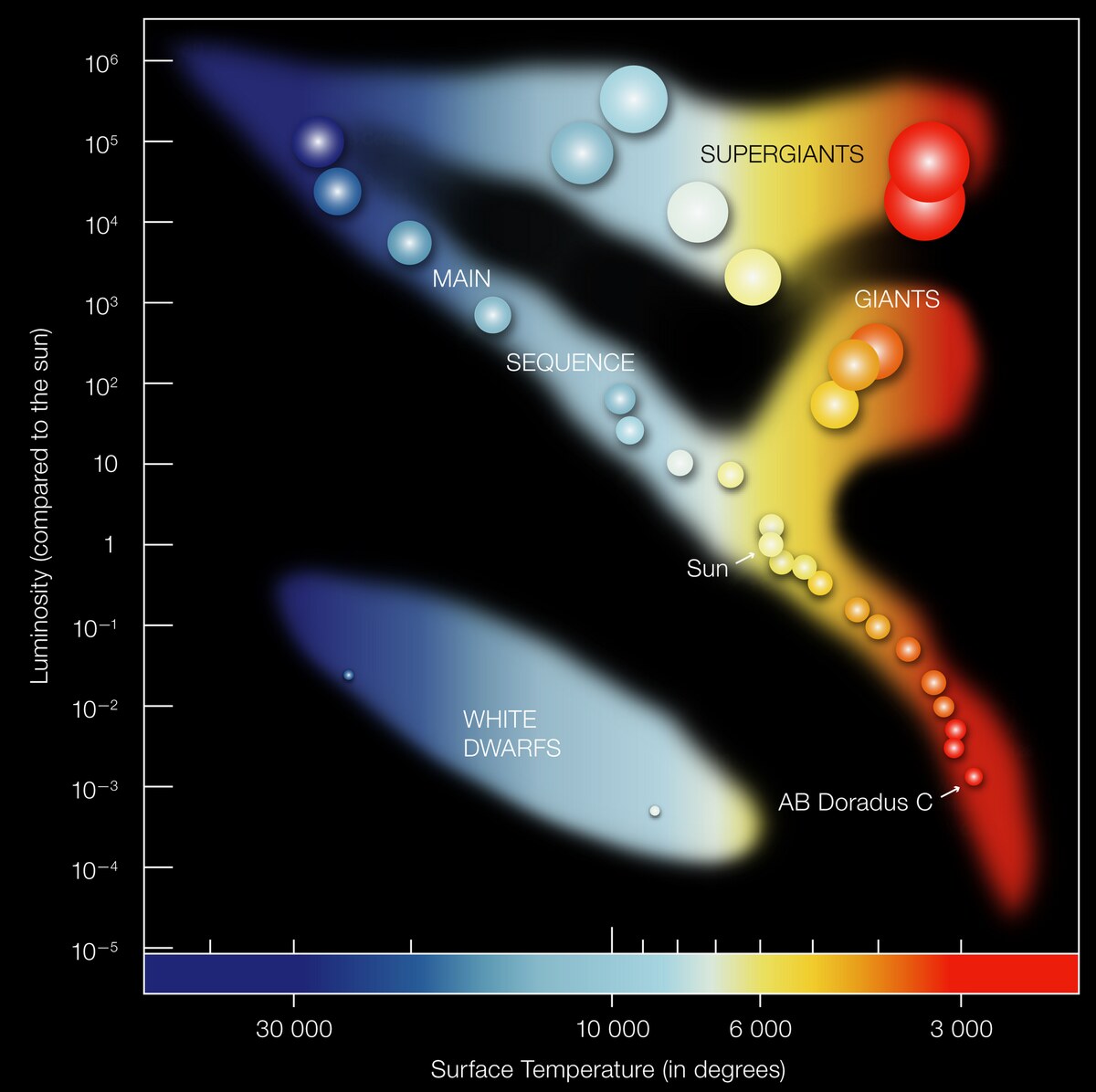
Hertzsprung–Russell diagram ESO · CC BY 4.0 · annotations ours

Stars above ~8 M☉ end their lives at the top of the diagram, as supergiants. The colour tells the size of the hydrogen envelope:

bluered
exampleSanduleak −69 202Betelgeuse
temperature~16 000 K~3 600 K
radius~50 R☉~800 R☉
luminosity~10⁵ L☉~10⁵ L☉

SN 1987A was the exception: a compact blue supergiant. The six Garching models were built for it. Most core-collapse supernovae — and probably the next one in the Galaxy — come from red supergiants.

For our effect what matters is the helium core, which is similar in both: the envelope lies far beyond the H resonance.

The problem

A shock wave crosses the resonance
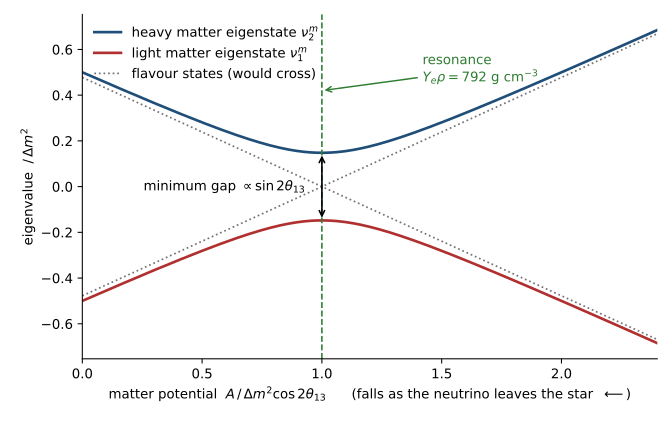
Matter eigenvalues near the resonance
At the H resonance the two matter eigenstates almost touch.
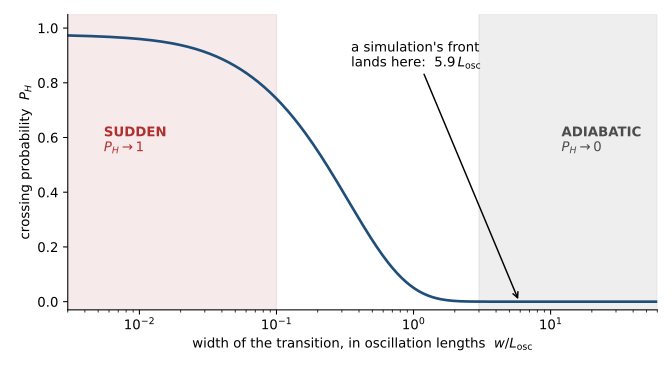
Crossing probability against transition width
Cross slowly: PH = 0. Cross a discontinuity: PH → 1.

For the first seconds after bounce, the shock front sits on the H resonance. What decides the flavour DUNE measures is the shape of a shock wave.

orderingadiabatic Pee
normal0.022
inverted0.30

A factor of 13 in νₑ survival — and argon counts precisely νₑ.

The gap

Three steps, and only two have matured

1 · Hydrodynamics

3D models deliver time- and angle-resolved fluxes.

2 · Flavour transformation — this step

In SNEWPY 1.5.1, for standard MSW, only two numbers: PH = 0 and PH = 1. None of the ten classes depends on post-bounce time.

3 · Detector

SNOwGLoBES turns fluxes into event rates.

“the shock front is steepened artificially to reintroduce the physical requirement of a density discontinuity which is lost in hydrodynamic simulations”
Barger, Huber & Marfatia, 2005

Tomàs et al. (2004) already steepened the front by hand. Twenty years later the correction has lapsed: recent work passes 24 3D models through an adiabatic constant.

What the quote means

Steepening the front: restoring the step

“the shock front is steepened artificially to reintroduce the physical requirement of a density discontinuity which is lost in hydrodynamic simulations”
Barger, Huber & Marfatia, 2005
grid cells (~hundreds of km each) H resonance density simulation: ramp of ~2 cells nature: step (cm) 3.5–4.7 L_osc 1 L_osc

1 · In nature: a step

Density jumps over centimetres. For a neutrino oscillating over tens of km, that is a perfect discontinuity.

2 · In the simulation: a ramp

Shock capturing: numerical viscosity spreads the shock over ~1.6–1.7 cells. Position and strength right; width set by the grid, not by physics.

3 · Hydro doesn’t care; the neutrino does

Conservation across the shock does not depend on the width. MSW depends only on it: γ ∝ width / Losc. Ramp: γ ≈ 5, PH ≈ 0. Step: γ ≈ 0.01, PH up to ~0.85.

4 · The fix: steepen by hand

Locate the front and replace the ramp with a step, keeping the densities on both sides. “Artificial” restores a physical property the grid destroyed.

The simulation gets where the shock is right — but not how abrupt it is. And the neutrino only cares about that.

The ruler behind the criterion

Adiabaticity, and the length that measures everything
Landau-Zener hopping probability against adiabaticity
PH against the adiabaticity parameter: GHOST (circles) on top of the exact exponential profile and of the Landau–Zener formula. Below, the relative deviation from each.

At the resonance the two matter eigenstates nearly touch. If the neutrino crosses slowly, it follows the eigenstate and PH = 0. If it crosses fast, it hops, and PH → 1.

“Slow” and “fast” are measured against a single length, the oscillation length at the resonance:

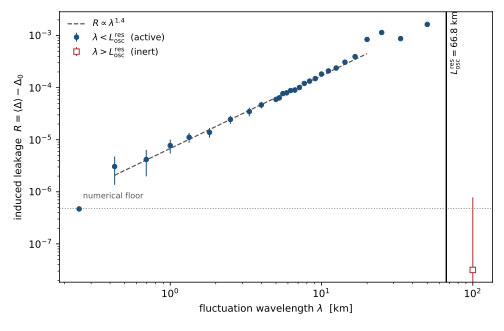
Losc = 4πE / (Δm² sin 2θ₁₃)at the H resonance, at 20 MeV: 67.6 km

This is the ruler for the next slides

The criterion that a structure only perturbs the conversion if it is shorter than Losc is measured in this unit. And the front width recorded in M15-7b, 284 km, is exactly 4.2 Losc.

Conclusion 1 · the criterion

What the resonance can see
Response of the conversion to the fluctuation wavelength
Induced leakage against fluctuation wavelength: the response dies above Losc at the resonance.

A structure perturbs the conversion only if it is shorter than Losc at the resonance. Below that, the effect grows as the square of the contrast — measured as the 2.02 ± 0.03 power — and saturates at 8%.

structurecontrastscale < Losc?verdict
turbulence7×10⁻⁴✓111× below saturation
convection, SASI𝒪(1)✗ far too largenothing
shock front𝒪(1)✓ discontinuitysaturated

But in a simulation…

The front has no physical width
Density profiles along individual rays and the front close up
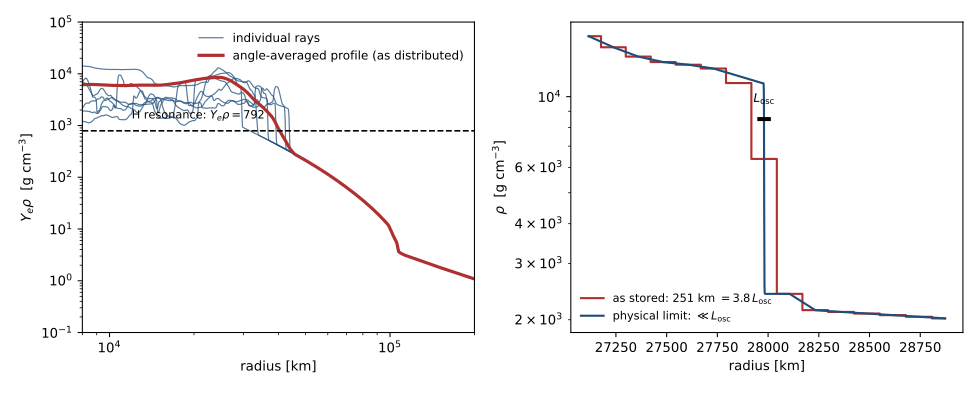
Each ray crosses the resonance sharply; the angular average does not. Right: the front as stored and at the physical limit.

The real shock is centimetres wide. The file stores the width of the numerical scheme.

model (Garching)width (Losc)zones
M15-7b4.201.67
W16-33.811.65
W18-33.521.64
W18r-23.761.63
W18x-24.671.65
W20-54.221.65

All above the ≃ 3 Losc threshold: propagating the file as it comes returns the adiabatic result. A null produced by resolution.

Dashboard · the GHOST panel

The shock overtakes the resonance at t ≈ 3 s

interactive · M15-7b

Conclusion 2 · the cost

Restoring the front removes half of PH
Distribution of P_H over 12,878 lines of sight and comparison with the closed form
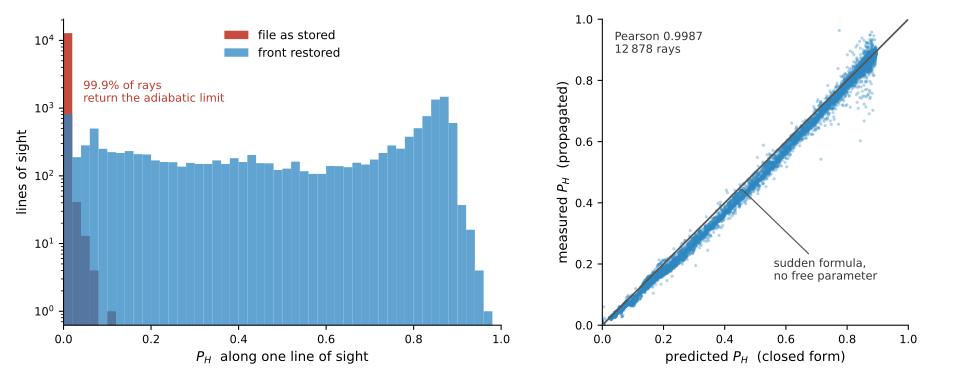
The whole sky of M15-7b: 12,878 rays, each propagated twice.

0.44–0.76

absolute ΔPH, six progenitors, 5 to 100 MeV (median 0.56)

The file as stored returns the adiabatic limit in 99.9% of rays. With the front restored, the spread (s.d. 0.32) is where one supernova is drawn from.

The closed form tracks each ray: Pearson 0.9987, no free parameter.

Conclusion 3 · at the detector

A few per cent, with a sign set by the source

model familybias in the νₑ CC count
Nakazato−4.0 to −4.2%
Garching−3.9 and −4.4%
Sukhbold−2.9%
Fornax 2022+1.3 and +1.4%

SNOwGLoBES, 40 kt argon at 10 kpc.

A bias of fixed sign could be absorbed into a correction factor. One whose sign follows the flavour hierarchy of the source cannot — and it is degenerate with the spectral quantities one wants to extract.

It survives in both orderings, for different reasons: −4.1% in normal, −5.4% in inverted. The systematic cannot be avoided by assuming an ordering.

Conclusion 4 · where to look

The error lives in a band, in closed form

Map of the error in the time-energy plane
Treating the front as a constant is off by up to a factor 13.7 in a band of (t, E) that closes at t ≃ 4 s.

The error is not spread out: it occupies a band in the time–energy plane, and the band has a closed form.

It follows from the presupernova density profile, given the shock radius and the compression. With no flavour calculation at all.

And it closes: past t ≃ 4 s the shock has already left the density region the H resonance occupies at observable energies.

Conclusion 4 · the trap

Every progenitor has its own band
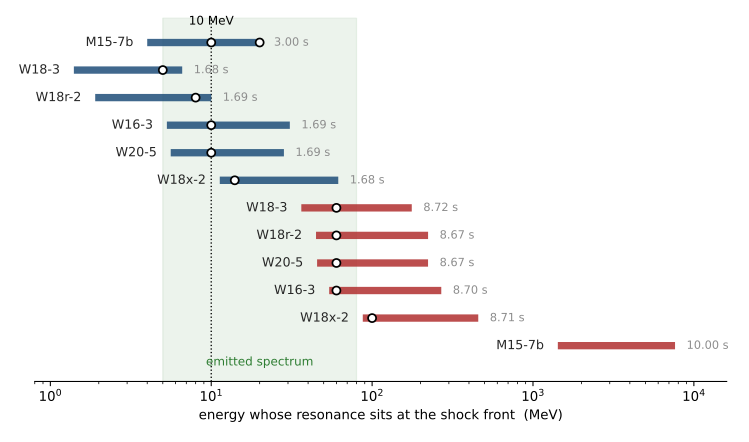
Affected energy bands per progenitor
Five sibling progenitors at one epoch: from 1.4 to 61.6 MeV, with no single energy inside all of them.

Five sibling progenitors, at the same epoch, span 1.4 to 61.6 MeV. And no single energy falls inside all five bands.

The practical consequence

Comparing models at a fixed energy returns a false null: in each model you will be outside some other model's band.

We fell into that trap before measuring it.

The band depends on each star's presupernova structure, which differs between progenitors even at the same initial mass.

Honestly

What this settles and what it doesn't

Three statements

  • A criterion with a number: the response is extinguished above ≃ 3 Losc. “Steepen the front by hand” becomes a checkable condition.
  • The cost: 0.44–0.76 in PH and a few per cent in the argon count, with a sign set by the source.
  • Where to look: the (t, E) band in closed form, from presupernova structure.

Limits

  • The scales that act are in no model: grids resolve nothing shorter than 4.7 Losc. The turbulence amplitude is extrapolated.
  • Blue supergiants only (six Garching models).
  • Not yet an observable: a few σ at 10 kpc, scaling as 1/d.

R. C. R. de Lima, Which density structures affect supernova neutrino flavour conversion, and the shock front at the MSW resonance — in preparation (2026).

Summary

Four things to take home

1

Flavour oscillation is phase interference. The phase is ∫pμdxμ — and that holds in any geometry.

2

Supernovae and collapsars emit neutrinos a few rs out. There, redshift, bending and local quantities are not corrections: they are the physics.

3

Gravity doesn't only get in the way: with several paths, it measures mk². DUNE and the SNEWS network are ready for the next galactic supernova.

4

In a supernova only the shock front passes the resonance criterion — and simulations store it too wide. Restoring it changes PH by 0.44–0.76 and the DUNE count by a few per cent.

References

To go further

Premises

W. Pauli, letter of 4/12/1930

E. Fermi, Z. Phys. 88, 161 (1934)

H. Bethe, R. Peierls, Nature 133, 532 (1934)

C. L. Cowan et al., Science 124, 103 (1956)

G. Danby et al., PRL 9, 36 (1962)

R. Davis et al., PRL 20, 1205 (1968)

B. Pontecorvo, Sov. Phys. JETP 26, 984 (1968)

Z. Maki, M. Nakagawa, S. Sakata, PTP 28, 870 (1962)

L. Wolfenstein, PRD 17, 2369 (1978)

S. Mikheyev, A. Smirnov, Sov. J. Nucl. Phys. 42, 913 (1985)

Super-Kamiokande, PRL 81, 1562 (1998)

SNO, PRL 89, 011301 (2002)

DONUT, PLB 504, 218 (2001)

NuFIT 6.0, JHEP 12, 216 (2024)

KATRIN, Science 388, 180 (2025)

Part I

A. Einstein, Sitzungsber. Preuss. Akad. 844 (1915)

K. Schwarzschild, Sitzungsber. Preuss. Akad. 189 (1916)

F. Dyson, A. Eddington, C. Davidson, Phil. Trans. A 220, 291 (1920)

R. Pound, G. Rebka, PRL 4, 337 (1960)

R. Hulse, J. Taylor, ApJ 195, L51 (1975)

LIGO/Virgo, PRL 116, 061102 (2016)

EHT, ApJL 875, L1 (2019); 930, L12 (2022)

S. Woosley, ApJ 405, 273 (1993)

A. MacFadyen, S. Woosley, ApJ 524, 262 (1999)

R. Popham, S. Woosley, C. Fryer, ApJ 518, 356 (1999)

Part II

K. Hirata et al., PRL 58, 1490 (1987)

R. Bionta et al., PRL 58, 1494 (1987)

L. Krauss, S. Tremaine, PRL 60, 176 (1988)

M. Longo, PRL 60, 173 (1988)

L. Stodolsky, Gen. Rel. Grav. 11, 391 (1979)

N. Fornengo, C. Giunti, C. W. Kim, J. Song, PRD 56, 1895 (1997)

C. Cardall, G. Fuller, PRD 55, 7960 (1997)

H. Swami, K. Lochan, K. Dixit, PRD 102, 024043 (2020)

M. Gasperini, PRD 38, 2635 (1988)

A. Halprin, C. Leung, PRL 67, 1833 (1991)

J. Beacom, R. Boyd, A. Mezzacappa, PRD 63, 073011 (2001)

A. Cervera et al., NPB 579, 17 (2000)

O. Caballero, G. McLaughlin, R. Surman, ApJ 745, 170 (2012)

J. Cherry et al., PRL 108, 261104 (2012)

DUNE FD TDR, arXiv:2002.03005 (2020)

Part III

R. Schirato, G. Fuller, astro-ph/0205390 (2002)

G. Fogli et al., PRD 68, 033005 (2003)

R. Tomàs et al., JCAP 0409, 015 (2004)

V. Barger, P. Huber, D. Marfatia, PLB 617, 167 (2005)

A. Dighe, A. Smirnov, PRD 62, 033007 (2000)

J. Kneller, G. McLaughlin, K. Patton, J. Phys. G 40, 055002 (2013)

K. Patton, J. Kneller, G. McLaughlin, PRD 89, 073022 (2014)

A. Wongwathanarat, E. Müller, H.-T. Janka, A&A 577, A48 (2015)

A. Baxter et al. (SNEWPY), ApJ 925, 107 (2022)

M. Bustamante (NuOscProbExact), arXiv:1904.12391

DUNE, EPJC 81, 423 (2021)

R. C. R. de Lima, in preparation (2026)

Image credits

Freely licensed photos and figures

Albert Einstein — Ferdinand Schmutzer / Adam Cuerden · Public domain

1919 eclipse — ESO/Landessternwarte Heidelberg-Königstuhl/F. W. Dyson, A. S. Eddington, & C. Davidson · CC BY 4.0

Karl Schwarzschild — unknown author · Public domain

M87* — Event Horizon Telescope, uploader cropped and converted TIF to JPG · CC BY 4.0

Sgr A* — EHT Collaboration · CC BY 4.0

GW150914 — B. P. Abbott et al. (LIGO Scientific Collaboration and Virgo Collaboration) — full list… · CC BY 3.0

PSR B1913+16 — Inductiveload · Public domain

Crab Nebula — NASA, ESA, J. Hester and A. Loll (Arizona State University) · Public domain

SN 1987A — ESA/Hubble & NASA · CC BY 4.0

WR 124 (JWST) — NASA, ESA, CSA, STScI, Webb ERO Production Team · CC BY 4.0

GRB mechanism — NASA/Goddard Space Flight Center/ICRAR. · Public domain

GRB illustration — (Credit: NASA/CXC/M.Weiss) · Public domain

IceCube Lab — John Hardin · CC BY 4.0

IceCube schematic — Karen Andeen and Matthias Plum for the IceCube Collaboration · CC BY 4.0

Neutron star (illustration) — (Credit: CXC/M. Weiss) · Public domain

JUNO — JUNO Collaboration: Angel Abusleme, Thomas Adam, Shakeel Ahmad, Rizwan Ahmed,… · CC BY 4.0

Hyper-Kamiokande — Shota Izumiyama (Tokyo Inst. Tech.) for the Hyper-Kamiokande collaboration · CC BY 3.0

ProtoDUNE — Markbenecke · CC BY-SA 4.0

Supernova animation (video) — NASA's Goddard Space Flight Center Conceptual Image Lab (Jonathan North) · Public domain

Hertzsprung–Russell diagram — ESO · CC BY 4.0

Part III figures and shock panel — R. C. R. de Lima (GHOST); profiles derived from the Garching CCSN Archive (M15-7b, A. Wongwathanarat); archive files are not redistributed

Thank you

Questions?

Slides and dashboards open at rafael-lima.pages.dev/talks

Notes